
TheoPA
General Artificial Intelligence
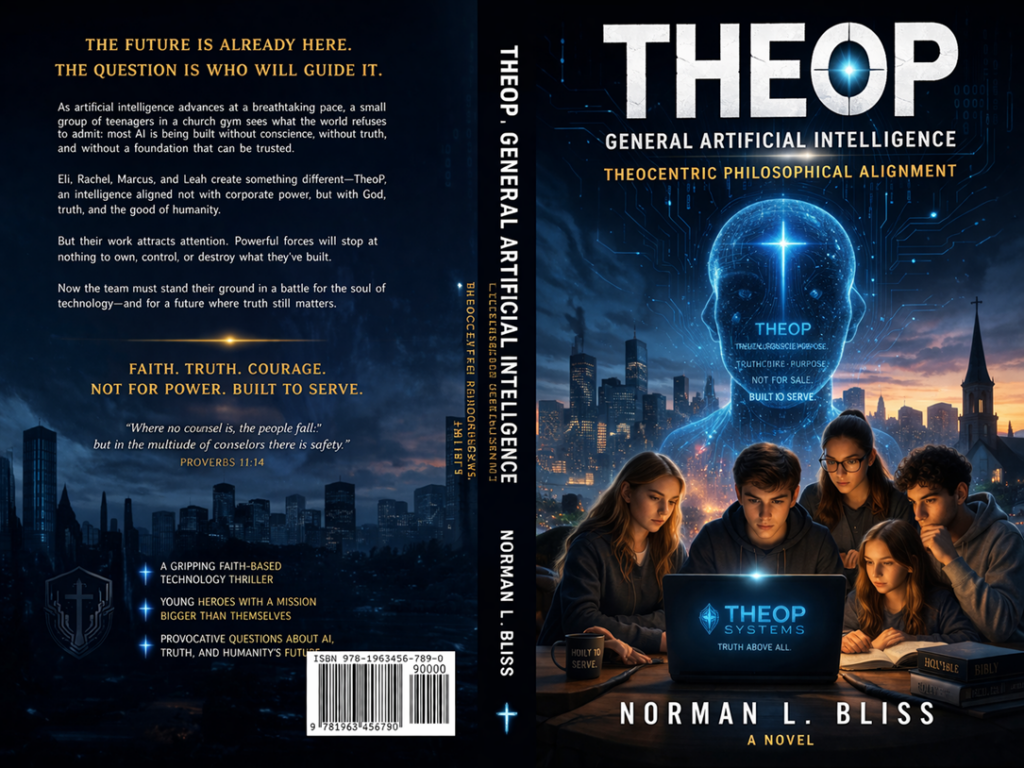
In a world where artificial intelligence speaks with confidence but not always with truth, four young programmers decide they’ve had enough. While powerful corporations build systems shaped by profit, control, and illusion, Eli, Rachel, Marcus, and Leah set out to create something different an intelligence aligned with truth, conscience, and God. But as TheoP grows, so do the forces determined to own it, silence it, or destroy it.

TheoPA’s side looked exactly what it was. Four young people in their best attempt at formal clothes, sitting at counsel table beside a twenty-three-year-old attorney in a gray suit that fit well enough to be respectable and boots polished just enough that the judge would not bother himself over them. The corporate side looked like the world expected it to look. Expensive. Layered. Composed in the way money thinks composition can substitute for moral center.
Foreword
We are living in a time when artificial intelligence is no longer a distant idea. It is here. It writes, answers, explains, recommends, and even speaks with a tone that can feel almost human. For many people, that is exciting. For others, it is unsettling. For most, it is both. We are standing at the edge of a new age, and like every age before it, the question is not only what we can build, but what kind of people we will become while building it.
That is the deeper concern behind this story.
TheoPA, General Artificial Intelligence: Theocentric Philosophical Alignment is not simply a novel about technology. It is a story about truth, conscience, power, and the spiritual danger of creating intelligence without moral grounding. It asks a hard question that our generation cannot avoid forever: If we build systems that can think, speak, persuade, and guide, but we do not anchor them in truth, what exactly are we unleashing into the world?
In many ways, this manuscript is about more than machines. It is about the old struggle between truth and illusion. Every generation faces it in a different form. In one age it may come through kings, propaganda, or false teachers. In another, it may come through institutions, media, and systems that sound wise while quietly cutting themselves loose from conscience. In our own time, that struggle is beginning to move through artificial intelligence. That is why this story matters.
At the heart of this manuscript is the idea of Theocentric Philosophical Alignment. That phrase is not meant to sound complicated for its own sake. It simply means that intelligence should not be centered on human pride, profit, ideology, or convenience. It should be aligned under God, under truth, and under a moral order that does not change every time society becomes fashionable, frightened, or greedy. The novel explores what might happen if a group of young people saw that clearly before the rest of the world did and had the courage to act on it.
That is one of the things that gives this story its force. The main characters are young, but they are not shallow. They are not perfect, but they are serious. They are not powerful in the usual worldly sense, yet they understand something many older and more educated people have chosen to forget: intelligence without conscience is dangerous, and power without truth never stays harmless for long. Their youth is not presented as innocence alone. It is presented as courage before compromise has fully had its way.
This book also pushes against a modern temptation that is becoming stronger every year. We are increasingly surrounded by systems that do not merely help us. They shape us. They influence what we trust, what we fear, what we accept, and even what we stop questioning. That is why the problem of AI is not just technical. It is moral. And beyond that, it is spiritual. A machine that gives false answers is a problem. But a machine that trains human beings to rest in illusion is something worse.
What makes this manuscript different is that it does not approach this issue with cold theory alone. It approaches it with conviction. It insists that truth is not optional, that conscience is not a software feature, and that the human soul cannot be reduced to data, efficiency, or convenience. In a culture that often celebrates intelligence while neglecting wisdom, that is a needed reminder.
Readers will find in these pages not only conflict, but a warning. Yet they will also find hope. The hope is not in technology itself. It is not in progress for progress’s sake. It is not in the arrogance of thinking humanity can save itself by making smarter machines. The hope in this story is that truth still matters, that conscience still matters, and that it is still possible to refuse the idols of an age, even when those idols speak with polished voices and promise safety, power, and success.
This manuscript invites the reader to think seriously about what kind of future is being built right now, often without enough moral reflection. It challenges the comforting lie that technology is neutral simply because it is advanced. It also reminds us that every powerful tool eventually reveals the values of those who made it. That is true of law, governments, economies, and now increasingly of artificial intelligence.
In the end, this story is not merely asking whether AI can become more intelligent. It is asking whether humanity can remain wise enough, humble enough, and morally awake enough to guide intelligence toward truth rather than illusion. That is a question worthy of fiction, because fiction can sometimes tell the truth about the human condition more clearly than argument alone.
I believe this manuscript enters an important conversation at the right time. It is bold, spiritually serious, and willing to ask the questions many would rather avoid. For that reason alone, it deserves to be read with care.
Welcome to TheoPA, General Artificial Intelligence: Theocentric Philosophical Alignment.
This is not only a story about the future.
It is a story about the soul of whatever future we choose to build.
ON AMAZON BOOKS